
University Senate : Members discuss high paper usage, enrollment committee research

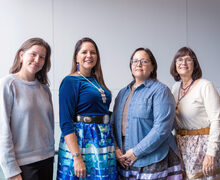
Mary Lovely, chair of the Ad Hoc Committee on Enrollment, shares initial research on overcrowded classrooms during Wednesdays meeting.
University Senate members expressed concerns about high paper usage at the final USen meeting of the academic year on Wednesday.
When presiding officer Jonathan Massey opened the floor for new business in Maxwell Auditorium, Melissa Kizina, secretary of the Graduate Student Organization, spoke up. She asked if other USen representatives file away their paper after the meeting or toss it in the trash.
‘I just noticed the sheer amount of paper we use for our packets and envelopes,’ said Kizina, a third-year composition and cultural rhetoric doctoral student.
Kizina’s questions sparked discussion on whether USen should go green and strictly use electronic versus paper packets. Some members suggested solutions, such as having members request paper documents and having a bin at the front of the room to dispose of documents after the meeting ends.
Some committees, such as the Committee on Curricula, have already gone completely electronic. Many USen members expressed interest in conserving or recycling paper, but some were hesitant to rely completely on technology.
Don Saleh, vice president for enrollment management, said USen documents sometimes contain sensitive information that shouldn’t be recycled carelessly. This could require someone to be in charge of disposing the bin’s contents after each meeting, Kizina said.
Massey concluded the discussion by saying the topic would need to be brought up again at the first USen meeting next fall.
Also during the meeting, the ad hoc committee presented an update on one of its reports, and USen members voted to add several new programs, including a minor in medical anthropology and an integrated learning major on energy and its impacts. The Senate Agenda Committee, the Committee on Appointment and Promotions, the Committee of Curricula and the Academic Affairs Committee also presented reports.
After doing research with the help of faculty, the Ad Hoc Committee on Enrollment is in the process of creating an interim report, said Mary Lovely, chair of the ad hoc committee. The committee began research on overcrowding in classrooms as a result of a bulge in the size of this year’s freshman class.
The research had two components: a survey given to faculty and a collection of data with the help of the Office of Institutional Research and Assessment. The online survey had 33 percent faculty participation, Lovely said. The committee plans to turn the data into graphs and visuals to present to USen, and hopes to be done with the project by the beginning of July, she said.
Though the faculty response is ready for analysis by the group, the committee will continue to work on the student research portion through the summer, Lovely said.
‘The cooperation and work on this report has been amazing,’ Lovely said.
Motions were passed during the meeting to accept a list of promoted faculty and a list of retiring faculty. Motions were also passed to approve proposed updates and improvements on assignments for committees next year, and to vote on changes to curricula and programs. USen voted on representatives to replace those whose term with the Senate Agenda Committee was up as well.
The meeting concluded when a senator proposed that the group thank Massey, who is stepping down as the presiding officer, for his leadership. The senators applauded Massey’s service.
Massey drew a few chuckles when he concluded the meeting by saying, ‘It has been a pleasure, but not all the time.’
*****
Published on April 20, 2011 at 12:00 pm