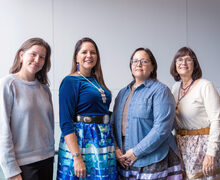

Many voices, one identity: Individuals connected through Hispanic heritage

Hispanic Heritage Month is wrapping up. Here’s a look at four individuals in the Syracuse community who say they celebrate their Hispanic heritage every day.
Fanny Villarreal
From judge to supermarket cashier, Fanny Villarreal has done it all. Originally from Peru, she followed her sister to Syracuse in 1991. Since then, Villarreal has been an active part of the community as the former executive director of the Spanish Action League. She has also worked as a bilingual social worker for Catholic Charities and is currently a community engagement specialist for Onondaga County.
Even those who don’t ask will often learn about the different aspects of Villarreal’s culture. She tells everyone she meets about her family and the traditions it upholds.
‘A lot of people don’t really know about our culture here, and I personally think it’s something we should be celebrating all year long,’ Villarreal added with a smile. ‘I’m always celebrating that I’m from Peru.’
Each year, Villarreal helps organize ceremonies and awards for National Hispanic Heritage Month.
Villarreal said she works hard to make sure Hispanic events are not just for people of Hispanic heritage. She makes sure to open the invitation to everyone in the Syracuse community.
‘The purpose is for us to see each other as human beings, all of us, for all the positive things we have done.’ she said. ‘I encourage everyone to ask me about the Hispanic community.’
Alejandro Garcia
‘Latinos have no culture.’ That’s what Alejandro Garcia’s childhood schoolteachers told him. The Syracuse University professor in the School of Social Work is of Mexican parentage and grew up in southern Texas. He remembers how he and his siblings spent their childhoods working in cotton fields and selling newspapers on the street.
‘It’s a world of difference between that time there and being a professor at a prestigious university like Syracuse University,’ said Garcia, who began teaching at SU in 1978. ‘But, nevertheless, it is important for us who have made it to look back … and to try to bring people forward, to help them be successful.’
Garcia is a member of the advisory board of La Casita, a university-Westside project and a supporter of the Community Folk Art Center, which he said holds several exhibits of his Mexican folk art collection and photographs. In April, Garcia was recognized by SU’s LGBT Resource Center for his photography of lesbian, gay, bisexual and transgender events and involvement in creating a photo history of the group. As part of Syracuse’s celebration of Hispanic Heritage Month, Garcia was named an outstanding educator and recognized for his contributions to the Latino community as a teacher and role model.
Maria de Lourdes Fallace
As a medical Spanish instructor at the State University of New York Upstate Medical University, Maria de Lourdes Fallace spends much of her time connecting Syracuse’s Spanish- and English-speaking communities. Originally from Ecuador, Fallace works with Upstate staff and students so they can communicate with patients.
‘Some of them … are very afraid to make mistakes or to miss an important word for a doctor,’ Fallace said. ‘And that’s why they really need trained interpreters. And it’s a fabulous experience that the medical doctors who have the know-how will learn the medical knowledge to build that bridge.’
With what Fallace describes as a rapidly increasing number of Cuban refugees in Syracuse, along with recent census data showing a 55 percent increase in Syracuse’s Hispanic population, she said more and more Spanish-speaking individuals are walking through those hospital doors.
‘(What we do) is very important because Syracuse has a very, very large Spanish-speaking population,’ Fallace said. ‘Even though we don’t see them all over the place, they are here.’
Fallace has lived in Syracuse for more than 40 years. She has held many positions on several boards, including her roles as a committee member of the American Red Cross and as the director of community service for former Mayor Roy Bernardi. She calls herself a big supporter of the city of Syracuse, and she says that is partially because she finds it to be a hospitable place for the Hispanic community.
‘It is funny, I really don’t think I have been stereotyped, and if I am, I don’t care,’ Fallace said with a shrug and a laugh. ‘But I really have been able to relate to people from all walks of life. I have been fortunate to serve in different boards, I have met people in a broader aspect, and I love it here. I have no complaints.’
Jonathan Reyes
As a newly elected member of Student Association’s general assembly, junior political science and psychology major Jonathan Reyes said he wants to increase Latino activity and representation on campus.
‘I joined SA to play a more active role in the Syracuse community,’ Reyes said. ‘And I don’t believe Latinos are represented in high numbers here at Syracuse.’
Reyes, who is of Dominican descent, said a greater representation does not require Latino students to limit themselves to that particular group. In fact, he points to multiculturalism as a way to get more people involved.
‘I’ve observed that the majority of students here, we simply limit ourselves,’ Reyes said. ‘I feel like it would help them strive higher if cultures were closer. … They’ll gain more confidence, and feel more accepted.’
Published on October 12, 2011 at 12:00 pm