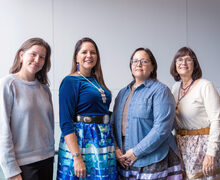

First step: Victims of sexual assault seek medical, forensic resources

Shijing Wang | Staff Photographer
A day after her assault in the fall semester, Jackie Reilly found out she no longer had much of the evidence needed to prove what had happened to her.
Prior to going to Crouse Hospital, she said she showered, changed clothes and went to the bathroom, destroying any proof that she had been raped.
“I just wish I knew that before,” Reilly, a sophomore graphic design major, said in an email. “I would have gone to the hospital the second after I had gotten home, so I would have more proof if I wanted to pursue a court case.”
Not only that, but after hours of waiting, she found out the hospital didn’t even carry the specific test that would identify the type of drug inside her.
“By that time, if I had gone to another hospital that may or may not have had a date-rape drug test, the drugs would have left my system,” Reilly said.
Last week, a series of organizations hosted SU Rising, an event at Hendricks Chapel that called for better assistance for women who have been assaulted in some way. Sexual assault victims make up a large part of that demographic. Almost 1-in-5 women have been sexually assaulted during their time in college, according to The White House Council on Women and Girls. While some progress has been made, victims still have to go through many obstacles following their assaults.
Although Reilly was told it seemed like she was drugged, she said she couldn’t officially prove that was the case.
“That is the tricky part,” she said. “They don’t stay very long in your system so they are hard to test for if you do not go in immediately.”
Janet Epstein, the director of the Advocacy Center at SU, said drug testing post-assault is complicated because many of the drugs used to facilitate sexual assault leave a person’s system within 12-24 hours.
Anne Gallagher, a nurse with Sexual Assault Nurse Examiners, said hospitals’ equipment can’t always detect small amounts of drugs that might be in a victim’s system. To find out if a victim has been drugged, the victim has to go through a forensic evidence examination and file a police report so the kit can go to crime lab.
If victims do not want to report to the police, they can send their blood and urine to a private laboratory at their expense, Gallagher said.
According to the Rape, Abuse and Incest National Network, the U.S. Department of Justice estimates that less than 5 percent of completed and attempted rapes of college women are reported to police. For the general population, 40 percent of all sexual assaults are reported.
Gallagher said victims might feel reluctant to report because they might worry about the fact that they’ve been drinking underage and doing drugs, which may lead to trouble with the law.
“What I want people to know is that they can go to the hospital without ever contacting the police and the hospital should not be contacting them on their behalf,” she said. “They can be cared for medically if all they want is the morning-after pill or if all they want is HIV-post exposure prophylaxis. If it’s appropriate, we’ll offer it.”
When victims go to a hospital, the nurses do an examination and testing for health-related concerns, Epstein said. This is separate from collecting evidence from the victim, she added.
Epstein said rape kits, known as forensic exam kits, aren’t processed as evidence in the hospitals. Instead, they get shipped out to a lab in Onondaga County. The lab technicians only run the tests if the survivor gives permission and seeks prosecution, she added.
Once victims go through an examination for immediate health concerns, they can choose to have evidence collected. If evidence is collected, the victims don’t have to report the assault to the police.
However, the hospital has to keep the evidence for at least 30 days, Epstein said. The nurse would then check and see if the victim still wants to keep the evidence or have it destroyed.
Most emergency room nurses and physicians don’t get specific training on how to help a victim of sexual assault, Gallagher said.
Caring for a sexual assault victim isn’t easy because of the “emotions involved in the process,” she said, adding that some health care providers don’t want to say anything insensitive to the patient. They also might not understand how someone becomes victimized.
Before the SANE program came to Syracuse in the 1990s, nurses who had never used a rape kit would be given the instructions and conduct the examination while they read them, Gallagher said.
Epstein said the program’s nurses, called SANE nurses, work at local hospitals to provide evidence collection, testing and treatment for those who have been sexually assaulted. The SANE nurses go through training on how to collect evidence and handle victims’ trauma, Epstein said, and the victim is always asked for his or her consent as the nurse walks through every step with the victim.
President Barack Obama created a national task force as another solution. On Jan. 22, Obama announced that a task force to protect students from sexual assaults is necessary. According to the press release, the task force will create plans and recommendations for Obama by April 22, including suggestions for possible instructions and policies on rape and sexual assaults to universities. By next year, the task force will report to Obama on how the policies have been implemented.
While most rape victims are nervous to report their cases, it is helpful to meet others with similar experiences. Reilly said her nurses at Crouse were rape victims.
“I remember that my nurses were the nicest of women,” she said. “They themselves were rape victims, so they were very helpful with dealing with me emotionally.”
Published on February 19, 2014 at 3:35 am